The Blue Mansion: A Living Testament to Heritage, Indigo, and the Art of Restoration
I first encountered the Cheong Fatt Tze Mansion not through a guidebook, but through a story. Years ago, while researching architectural conservation in Southeast Asia, a colleague mentioned a “blue house” in Penang that had been brought back from the brink of ruin. Not just restored, but resurrected with a painstaking, almost obsessive dedication to authenticity. The phrase “Indigo Blue” was uttered with a reverence usually reserved for a holy site. My curiosity was piqued. When I finally stood before its imposing, cerulean façade on Leith Street, I understood. This wasn’t just a house museum; it was a masterclass in cultural memory, a dialogue between past and present written in plaster, timber, and that unforgettable, soulful blue.
_overview.jpg)
The Man and His Monument: More Than a Merchant’s Home
To grasp the mansion’s significance, you must first understand the man who built it. Cheong Fatt Tze (1840-1916) wasn’t just a wealthy merchant; he was a phenomenon. A Chinese immigrant who rose from poverty to become a financial titan, his network stretched from the Dutch East Indies to China, earning him the nickname “The Rockefeller of the East.” The mansion, completed in the 1880s, was his statement piece in Penang, a node in his vast commercial empire and a home for his beloved seventh wife.
But here’s what most summaries miss: this building is a physical manifesto of Cheong Fatt Tze’s worldview. It’s a stunning fusion of styles, but not a haphazard one. The layout is strictly Feng Shui, with a central air-well (the “sky well”) acting as the lung of the house, drawing in light and air while symbolically collecting wealth. The ornate, swallow-tail roof ridges and intricate plaster mouldings are pure Southern Chinese Hokkien style. Yet, look closer at the louvred windows, the geometric Art Nouveau stained glass, and the Scottish cast-iron columns—these are British Colonial and Peranakan influences, seamlessly woven in. This wasn’t cultural appropriation; it was cultural confidence. Cheong Fatt Tze was saying, “I am rooted in my tradition, but I am also a citizen of the modern, global world.” The mansion is his autobiography in architecture.
The Colour of Memory: Unpacking the “Blue”
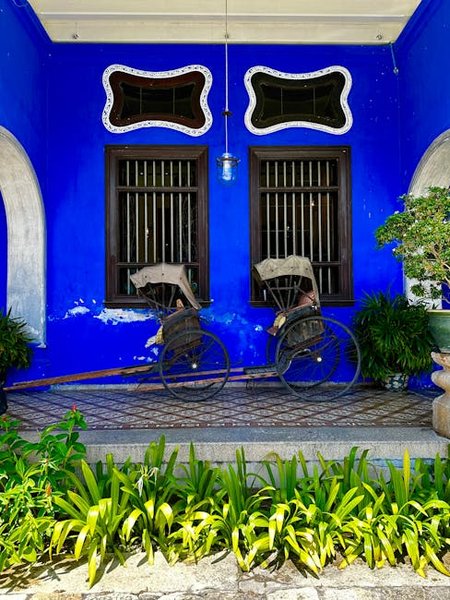
Let’s address the elephant in the room, which is, wonderfully, the entire house. That blue isn’t a mere aesthetic choice; it’s a technical and cultural artifact. The specific pigment is Indigo Blue, derived from the Indigofera Tinctoria plant. During my conversations with the conservation team, I learned this was no ordinary paint job. The original lime wash was mixed with natural indigo dye and egg whites, creating a surface that was not only vibrant but also fungicidal and cooling—a practical necessity in the tropical Penang heat.
The restoration in the late 1990s faced a critical juncture here. Modern synthetic paints would have been easier and cheaper, but they would have created a plastic-looking veneer and trapped moisture, dooming the historic plaster underneath. The team, led by architect Laurence Loh, made the brave decision to reverse-engineer the original recipe. They sourced natural indigo, experimented with ratios, and applied it using traditional methods. The result is a colour that breathes. It changes with the light of day—a deep, inky blue under monsoon clouds, a bright, cheerful cerulean in the midday sun. This single decision elevated the restoration from a repair job to an act of cultural revival. It taught me that true conservation isn’t about making something look old; it’s about understanding and replicating the logic of the old.
A Living Laboratory: The Mansion as a Case Study in Adaptive Reuse
After Cheong Fatt Tze’s death, the mansion, like so many grand homes, fell into a decades-long decline. By the 1990s, it was a crumbling, subdivided tenement. Its salvation is one of the most compelling case studies in adaptive reuse I’ve ever witnessed.
The new owners didn’t turn it into a static museum. Instead, they created a boutique hotel and a living cultural centre. This was a genius move. A museum might have preserved the shell, but a hotel needs the building to function. It requires plumbing, wiring, climate control, and comfort—all the things a modern user demands. The challenge became: how do you insert 21st-century infrastructure into a 19th-century structure without violating its soul?
The solutions were ingenious and respectful. Air-conditioning units were discreetly tucked away. New bathrooms were added in secondary spaces, leaving primary rooms intact. The original timber floorboards were numbered, removed, repaired, and relayed. What visitors experience today is not a fossil, but a living building. You can book a room in the “Gold Room,” sleep under the original carved panels, and hear the tropical rain on the 100-year-old roof tiles. This generates revenue, which in turn funds ongoing maintenance—a sustainable model for heritage preservation. It proves that historic buildings don’t have to be financial burdens; they can be viable, vibrant enterprises.
Lessons from the Lime Wash: Pitfalls and Best Practices
Working on and studying projects like the Blue Mansion has taught me invaluable, often hard-won lessons about heritage conservation.
A major pitfall is the “quick fix” mentality. I’ve seen well-intentioned restorers use cement to repair old lime plaster. Cement is rigid and non-porous; traditional lime plaster is soft and breathable. When moisture inevitably gets trapped behind the cement patch, it forces its way out, blowing the historic plaster off the wall and causing far worse damage. The Blue Mansion team avoided this by relearning and using traditional lime plastering techniques, a slower, more expensive, but ultimately correct process.
Another common mistake is over-restoration. The urge to make everything look “perfect” and new can erase the patina of history—the gentle wear on a staircase, the slight fading of a colour. The mansion’s conservators showed remarkable restraint. They stabilized, repaired, and conserved, but they didn’t erase all traces of time. Some timber beams, still structurally sound, were left with their old cracks and nail holes. This honesty gives the building depth and authenticity; it allows you to touch the hand of history.
The best practice, exemplified here, is minimal intervention. Your first question should always be: “What is the least we can do to ensure this building’s survival and safety?” Research is paramount. Before any work began, the Blue Mansion underwent years of archival research, material analysis, and oral history collection. They didn’t assume; they learned.
Beyond the Blue: Comparisons and the Future
How does the Blue Mansion model compare to other approaches? Contrast it with a place like The Forbidden City in Beijing. Both are meticulously preserved, but the Forbidden City is a monument to imperial power, preserved as a static, awe-inspiring museum. The Blue Mansion is a home, preserved through use. It’s a more intimate, sustainable model for smaller-scale heritage assets worldwide.
Or compare it to a full-scale replica, like many “historic” towns built from scratch. These lack the essential ingredient: authentic material. There is an irreplaceable aura in standing on floorboards worn smooth by Cheong Fatt Tze’s own family, in touching the same banister. The Blue Mansion’s value is in its tangible, original fabric.
Looking ahead, the mansion’s future seems secure, but the philosophy it represents faces challenges. The pressure for urban development, the loss of traditional craftspeople (the tukang who knew how to mix that lime wash), and the temptation of tourist-driven kitsch are constant threats. The mansion’s ongoing role as an educational centre is perhaps its most vital function. Their guided tours don’t just spout dates; they explain Feng Shui principles, construction techniques, and conservation ethics.
On my last visit, I sat in the central courtyard in the late afternoon. The light slanted through the stained glass, casting coloured patterns on the worn granite floor. A guest sipped tea in a quiet corner. The building wasn’t silent; it hummed with a quiet, purposeful life. It occurred to me that the greatest success of the Cheong Fatt Tze Mansion restoration is that it allows the building to continue its story. It’s not a closed book on a shelf, but an open, living narrative.
Cheong Fatt Tze built it as a bridge between his heritage and his cosmopolitan ambitions. Today, it stands as a different kind of bridge—between preservation and practicality, between history and hospitality. It proves that with enough passion, patience, and respect, we don’t have to choose between saving our past and living in our present. We can, quite beautifully, do both. The lesson of the Blue Mansion isn’t just about how to save a building; it’s a vivid, indigo-dyed reminder of why we should.